I just read Eowyn Crisfield’s post “The Importance of Monolingual Situations for Bilinguals“ about how to get children use the minority language. The most effective way is to build a social environment that shares the language(s). But this is not always possible.
Maybe you’ll find families who share the same language, but they don’t have children in the appropriate yeargroup, or these children don’t share the same interests with your children. In this case there are other solutions. DVD’s and TV aside, we found it very useful to read books, listen to audio books and Cd’s with nursery rhymes or songs.
If we read to our children right after birth and have the habit to read every day in a passionate way, this will not only help them with brain development, speech skills etc. but most probably they will be turning into passionate readers as well.
Especially if your children grow up in a multilingual environment, it’s vital to “feed“ them with books. In early years, reading aloud helps to develop vocabulary and “builds a strong emotional bond between parents and children“ and the language you’re reading to them. Even if they are big enough to read by themselves, if they’re not exposed regularly to the language, reading them aloud can be an important help for them to grasp the variances in phonics.
Reading is still the best way to build up a linguistic competence, not only it builds up vocabulary but it also helps to give our children an immediate and natural access to the grammar. Obviously it’s important that parents, as role models, read a lot too or that the kids’ peers love reading.
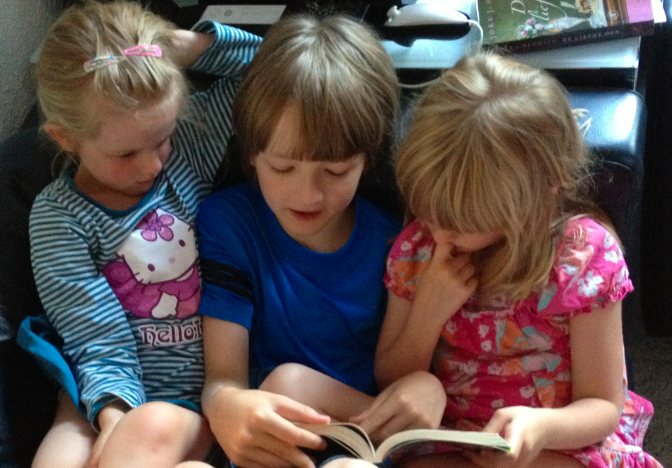
Why is reading so important for us? Well, it’s the time we can bond with our children. In our family we have a reading routine: every afternoon we sit and read for an hour. And we used to read to our children until they were able to read alone at bedtime. Now they prefer reading by themselves before sleeping but sometimes we all enjoy me or my husband reading to them. These are memories that our children will (hopefully!) remember when they will be parents too. I would even say that the habit of reading (a lot!) is a legacy I want to pass on to my children. And our children are passionate readers of German, Dutch and English books so far. – I guess I can say it’s already a success.
Obviously you can also rely on child appropriate TV channels in the minority language(s), to give your children a “language shower“. But TV is not a substitute for books.
If you are looking for shows for your children, try to choose wisely. Choose some where your children are stimulated to think, whose topics can be shared afterwards in a discussion with you or within the family or friends. Some shows for children are also accessible via internet.
You can also decide to buy or rent DVD’s in the minority language(s). We have several films in one to three of the languages our children are exposed to. Lately, while watching one of these films, my son (9) noticed that in the translated version some of the sentences weren’t translated in a very accurate way and came up with very good alternatives: this is one great aspect of raising multilingual children (and there are many more)!
Rita from did write posts about “Why reading is important” here and here.
Related articles
- Building Strong Readers (piplustutors.wordpress.com)
- Over 80 Films Dubbed In Minority Languages in Gansu Province (chinaheritagewatch.wordpress.com)
- Students Learn about the Importance of Reading (wtok.com)
- The Best Websites For English Language Learner Students In 2012 – So Far (larryferlazzo.edublogs.org)
- http://beingmultilingual.blogspot.nl/2011/03/learning-to-read-in-multilingual.html
- http://learnanylanguage.wikia.com/wiki/Word_lists
- Please check this later post about reading aloud to children: http://viviankirkfield.wordpress.com/2013/03/06/world-read-aloud-day-tips-on-reading-aloud-to-young-children/
Categories: Being multilingual, Multilingual children, Parenting




This is great! When I was more actively engaging in teaching my kids Russian, we read one story in Russian and one in English every night. It actually worked well. The unfortunate part was, I started decreasing the amount of time I engaged them in Russian otherwise. So their vocabulary was developing more slowly than their brains. They became bored with the little kids books, but weren’t capable of following more complicated books. We got stuck!
Thank you very much for sharing! What you experienced with your kids can easily happen. I remember that I started to like to talk german, when I spent four weeks in Germany one summer and made friends with peers. I observe the same with my children: they need to have a pleasant social context where to use the language and it is very important that peers are involved… How is it going with your kids’ Russian?
Hello Ute! I always enjoy reading your posts, though I rarely comment (due to lack of time). Anyways, reading has been an excellent source for language learning for our son, and reading your comment on the strong emotional bond that it creates excites me more! 🙂 Thank you for submitting this post to last month’s multilingual carnival! http://discoveringtheworldthroughmysonseyes.blogspot.com/2013/10/raising-multilingual-children-blogging.html
Hello Frances! Thank you very much for your comment. I completely understand. We have so many blogs to follow and leaving comments is not always easy. Anyways, I think personal inteaction: talking and reading and discussing about everything that comes into our minds is the best thing to learn a language and to keep it alive and interesting. Language is the way we connect and bond with people. – I loved your carnival-post and am still writing on the ebook. I’ll surely let you know when it’s more or less ready (I’ll need some people to proof read it first ;-)). Have a lovely evening/day xxx Ute